Saturday, February 16, 2019

Dialing in the Brakes, Steering, and Exhaust on my 1967 Mustang

Over the past year or so, I’ve been driving my ’67 Mustang a bunch. After all, it was my first car. I purchased it 19 years ago (for $2400) when I had just turned 17 years old in 2000. It has always run really strong for me, especially after the engine rebuild around 2012, when I also replaced the factory two barrel carb with a 4 barrel Holley, added an aluminum intake manifold, and abandoned the stock camshaft in favor of a warmed up cam from Comp Cams. Since the engine rebuild, I haven’t really changed much on the car and only drove it occasionally on weekends. This past year, I’ve put the Mustang in heavy rotation for any quick runs to the grocery store, out of town day trips, and almost any other driving that I could do. I decided to give a much-needed overhaul to the brakes, steering, and exhaust.


1967 Mustang


Brake Upgrade


When I had the car on the lift with easy access to all the brake and steering components, it made a lot of sense to do the Shelby drop at the same time. The Shelby or “Arning drop” was made popular on the early Shelby Mustangs and involved lowering the upper control arm mounting point lower by an inch, to achieve a flatter stance and better suspension geometry. This not only lowers the front of the car by an inch, but it noticeably improves the handing of the car after it’s done.


mustang disc brake conversion


I snagged a brake kit from Street Or Track, comprised of 13″ rotors up front and 12″ rotors in the rear. The massive front rotors are 1.25″ thick, and are genuinely race track quality. All the rotors are vented and slotted and are top of the line. Four piston calipers round out the brake kit, with a drum-in-hat emergency brake setup on the rear rotors.


mustang drum to disc conversion


Having the car up on the lift was a great opportunity to inspect all of the suspension components, and a set of SoT solid mount strut rods replaced the factory rubber bushing struts.


1967 mustang disc brake rotor


I also added a 1.25″ sway bar to keep things tight up front, and to take advantage of enhanced capabilities of the solid strut rods. With the disc brake kit, I also upgraded the factory spindles to a new set of spindles that will add significant strength over the original design.


classic mustang brake upgrade


I decided to upgrade my brake master cylinder from the original style to a new Wilwood master cylinder with an adjustable proportioning valve. This will allow for a much more customizable braking setup, allowing me to dial in the exact amount of bite that should be allocated to the front brakes versus the rear.


Here was the old setup:
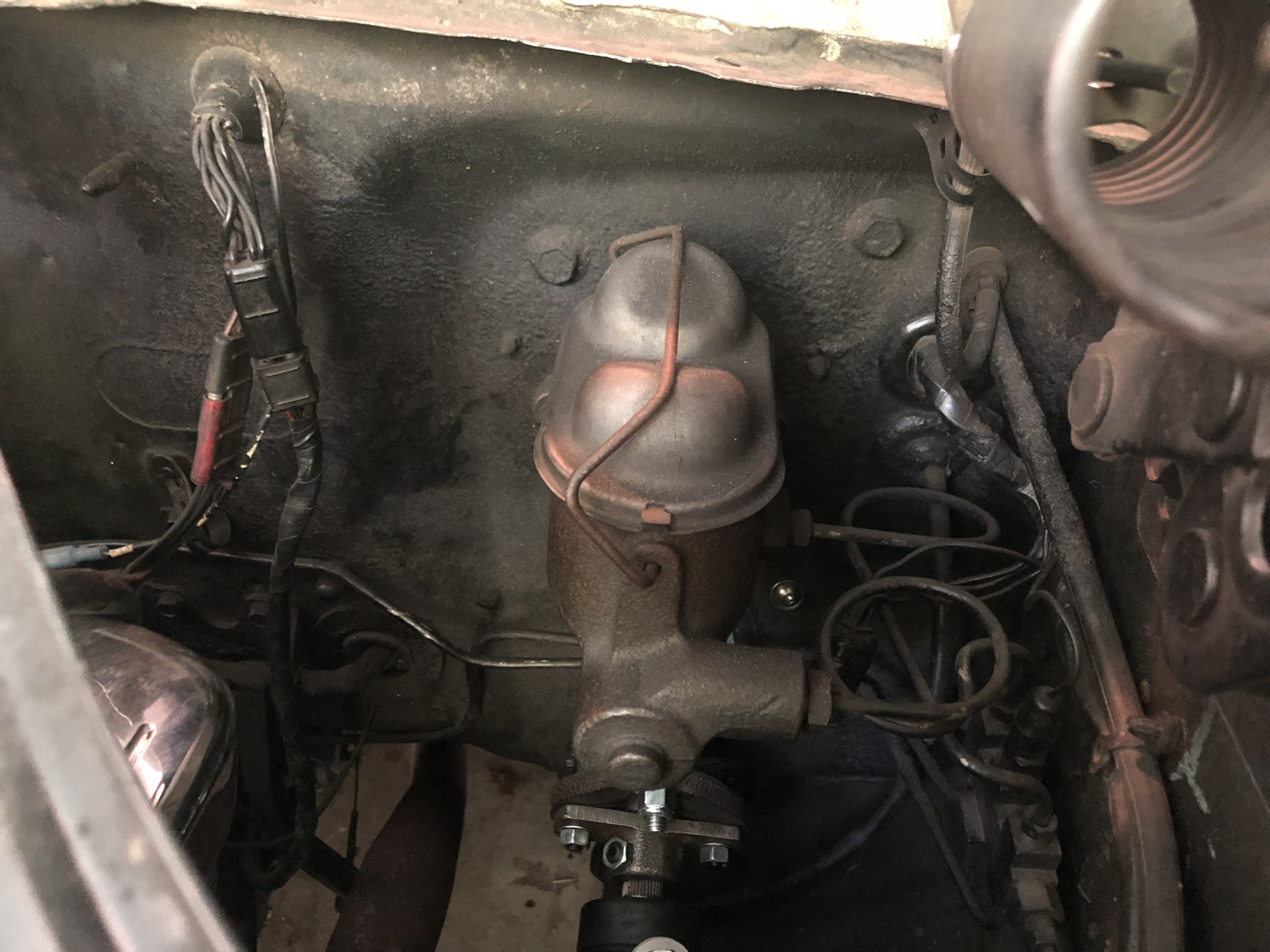


brake master cylinder 1967 mustang


Here’s the new Wilwood Master and Proportioning valve:


wilwood master cylinder 67 mustang


The brake upgrade was pretty smooth and straightforward, and the car now stops like a modern car. When it comes to brakes, my opinion is that there is no such thing as overkill. A good set of brakes calibrated correctly is a must have whether you’ve got a daily driver or a track-ready racer.


67 mustang 13" disc brake


Stance Upgrade


Ever since I have had my Mustang, I always wished that it sat just a little lower than it did. I wanted the perfect stance, and I feel like I achieved that upon completing the Shelby drop. The car now sits perfectly level from the front to the back, and the wheels/tires properly fill the wheel wells.


mustang disc brakes


The 13″ disc brake rotor and 4 piston caliper fit perfectly my American Racing Torq Thrust 2s.


frost turquoise Mustang


Steering Upgrade


The car came with power steering from the factory, but it’s a well known fact that the stock setup is way over boosted. I opted for a Borgeson quick ratio steering box, with a 14/1 ratio. The new steering box, combined with the Shelby drop, solid strut rods, and sway bar have made a huge improvement in the driving mannerisms. It handles way better!


frost turquoise 1967 mustang


Exhaust Upgrade


Now that the car is behaving properly on the road with her new braking and handling characteristics, it is time to take the exhaust system to the next level. The car had the original intake manifolds, old burned out glass pack mufflers, and 3/4 length turn down exhaust. For the new setup, I opted for a new set of Dougs Ceramic Tri-Y Headers, a MagnaFlow true X-Pipe, Borla CrateMufflers, and chrome exhaust tips.


exhaust 1967 mustang


borla 1967 mustang


I had a local exhaust shop install the exhaust. The system is running 2.5″ through the entire system. Let me tell you. The new setup sounds even better than it looks! And it looks amazing. I couldn’t be happier with the quality of components. Honestly – my car is now one of the best sounding Mustangs I have ever heard.


1967 mustang shelby drop


Once I got all the new components setup, I took it for a 500 mile road trip over to my brothers house where I met up with my dad and snagged some shots of our cars together. My Mustang ran so well. There are only a few bugs to be worked out. Here’s a quick video that I shot on the day that I got the Mustang back from the exhaust shop. Listen to those Borla’s purr!


The post Dialing in the Brakes, Steering, and Exhaust on my 1967 Mustang appeared first on Classic Nation.

Review: 2019 VW Jetta


It’s no small secret that Americans and Europeans have their differences, and one needn’t look any further to illustrate that point than to look at what kind of cars we like to drive. The 1970’s fuel crisis made a great argument for the hatchback-the idea being to get the maximum amount of room possible for people and cargo on a relatively small footprint. VW’s Golf was a raging success and proved the formula worked, and it was what a lot of people wanted. Well, almost everyone. For whatever reason, Americans looked at hatchbacks and decided they looked kind of cheap. And those new car buyers didn’t want to be seen driving something they perceived as being cheap looking. So, in 1980, VW had the brilliant idea to take the Golf, put on a trunk on it, and call it a Jetta.


Thirty nine years and seven generations later, that formula has been sales gold for VW. With Audi’s and BMW’s commanding premium prices, the Jetta was the only game in town if you wanted a German sedan on a budget most people could afford. And while the people who bought their Jettas loved them, VW looked around and saw their competition enjoying greater sales numbers. The problem, as I believe VW saw it, was the Jetta cost a little more, and VW engineers were obsessing over things the average American buyer didn’t really care about. The solution was the Jetta would be built with the American buyer in mind.


The purists were less than thrilled at the realignment. But the Jetta experiment continues to evolve, and for 2019 an all new, seventh generation has arrived. First impression is the Jetta appears a bit larger than Jettas of yore. And you would be right-today’s Jetta is around the same size as a Passat was twenty years ago. While the Jetta has grown to America specific proportions, the styling definitely has a German accent. It is no nonsense, not flashy nor trendy. The smart, creased styling gives the Jetta an upscale look. Our test car, finished in Platinum Grey Metallic with contemporary LED head and tail lights and a ‘just right’ amount of chrome looked serious enough for any junior executive to own without apology. Our SEL model let the car down in one area worth mentioning: the 16″ alloys look comically small on the car and betray the otherwise high end appearance. In fact, during my week with the Jetta, the only criticism I received about the car’s looks were that the wheels were too small.


Inside, the Jetta overall is a pleasant place to spend time. Utterly contemporary, the satin chrome accents and door handles, piano black surfaces and dark grey faux wood trim work in concert to provide an aesthetically pleasing environment. The controls are intuitive, displays crystal clear, and I appreciated the driver-focused infotainment screen. At night, you and your passengers will be entertained being bathed in soft ambient LED lighting-there are ten hues to choose from to set the right mood. The only letdown were the hard plastics found on the door caps and center console, which serve as reminders you’re sitting in the cheapest VW sold on these shores.


During my time with the Jetta, I took a 400 mile round trip from my native Connecticut to a wintry retreat to Atlantic City, and it was here I was able to appreciate the Jetta’s cabin and features. The seats provided plenty of comfort, and I loved how the steering wheel felt in my hands. Music is a must for any road trip, and the Beats audio did not disappoint. The trip really provided an excellent opportunity to use Apple CarPlay, which allowed me to use Google Maps for navigation, access Pandora radio, and send and receive text messages. It was a great companion, and very simple to use. Even after slugging through New York Friday rush hour traffic, I arrived feeling fresh and relaxed.


All Jettas are motivated by a 1.4L turbocharged four cylinder rated at 147hp. This proved to be perfectly adequate for merging onto highways and passing-the Jetta never felt out of breath. Fuel economy is excellent, with a rating of 30MPG city, 40MPG highway. After cruising at a pretty good clip for hours, I was impressed that I was still able to average 40MPG. You can get a six-speed manual in a Jetta-but you are forced to settle for the base model, as all other Jettas come standard with an 8-speed automatic. Left on its own, the automatic will rush to the highest possible gear for max efficiency, which is fine, but you find yourself constantly lumbering around at about 1,000 rpm where there is no boost on immediate tap. A friend and former Jetta owner found it an affront, and ignorant of longtime buyers that VW will not offer a manual across the line, and I agree.


In this Volkswagen tuned for American drivers, I set my expectations pretty low for ride and handling. I was pleasantly surprised. The Jetta feels well controlled and buttoned down. Ride was about as stiff as I would have hoped for a non-GLI Jetta. While the handling felt just right, the super light steering felt out of place, as if the handling people and steering people never once met to decide what the Jetta driving experience, as a whole, should be.


The Jetta is available in five trim levels-base S, SE, sporty R-Line, SEL, and SEL Premium. Our SEL test car came standard with LED head and tail lights, panoramic sunroof, heated front seats, leatherette seating, dual zone auto climate control, push button start, auto dimming rear view mirror, 8 speaker Beats audio with Sirius XM satellite radio, 8″ infotainment touchscreen, VW’s 10.25″ Digital Cockpit gauge cluster, rearview camera, forward collision warning, blind spot monitoring, adaptive cruise control, and lane assist. Including delivery, our test car stickers at $25,590USD, which represents a solid value for the features you get in return.


After seven generations, it’s only natural the Jetta has evolved from Golf with a trunk to a car with a personality all its own. Yes, the Jetta we see now is tailored specifically to the North American car buyer, but in this iteration, VW has smartly, if only slightly, moved the needle closer to it German ancestry. When asked ‘who is this car for?’, I would have to say the Jetta would be perfectly suitable for the small family who want out of the crossover craze, or anyone looking for an easy to live with highway commuter with a just right amount of amenities and style for a weekend date night.


Friday, February 15, 2019

How to put a number plate on retention

If you’ve bought your own personalised number plate from a private dealer or the DVLA, it is probable that you don’t want to change this when it comes to buying a new car. With The v778 Retention Certificate you can keep hold of your old number plate for a brand-new car without having to buy a new registration plate.


A retention certificate (or formally known as a V778 Retention Document) legally allows you to take the number plate off your vehicle and retain it for another.


If you want to sell your registration plate, on a site such as NewReg.co.uk, or use it on another vehicle then you’ll need this document in order to do so. Whether you have a replacement straight away or you’re waiting to sell it, applying for the V778 is simple, quick and can be done online.


Therefore, you do not have to wait weeks before you decide to find a buyer for the number plate.


The DVLA have made changes to their old system so that the retention certificate is now valid for up to 10 years. Before-hand, you would apply for the certificate depending on how many years you thought you would have to keep the plate under retention. The new system is much easier and you now also have the option to renew the certificate for another 10 years absolutely free if necessary. Applications for the initial certificate cost £80.


Are you eligible?


If this is something that you want to do, first you’ll need to check If your number plate is eligible to be retained and you must ensure that:


• The vehicle with the plate has been taxed to date
• The vehicle has been MOT’d to date
• You are the registered keeper of the vehicle, your name must be on the V5 log book
• The number plate is transferable


How to apply for the V778 Retention Document


If after reading the above, you believe you are eligible to have your number plate retained then you are able to apply for the V778 document two ways:


-For the quickest and easiest method, you can apply online
-If you’d prefer to apply via post, you can download the DVLA D317 form, complete it and post to the DVLA offices in Swansea, along with the original V5/V5C (Vehicle Registration Document).


What happens next?


If you’re documentation is approved then you will receive the V778 via post, as well as this, you will also receive a replacement registration number. If viable, the DVLA will reissue the vehicle’s previous number plate, however if this isn’t possible then the registration number will coincide with the vehicle’s age. You can replace this number plate with a private one at any point, however, you are unable to sell the replacement plate that you have received from the DVLA.


Before approval it is possible that the DVLA might want to inspect your vehicle, to confirm if it is eligible for the new registration number. They will check that your car has been taxed and MOT’d. If either have expired, then your vehicle will have to be transported to the DVLA office. As well as this, they will check your VIN number and chassis plate. If your application is declined, you may not get all of your fee back.


If and when your application has been approved, you will receive your V778 document, as well as a V5 registration document to show identify the replacement registration number. Instructions on how to extend your 10-year certificate are located on the back on the V778 document.


The post How to put a number plate on retention appeared first on Ultimate Car Blog | The Latest Car News, Reviews, Tuning.

2019 Canadian Car & Utility of the Year announced in Toronto


AJAC President Mark Richardson announces the winners in the John Bassett theatre to open the Canadian International Autoshow.


TORONTO, Ont. (February 14, 2019) – Today, the Kia Stinger was announced as the 2019 Canadian Car of the Year and the Jaguar I-Paceas the 2019 Canadian Utility Vehicle of the Year, as selected by the Automobile Journalists Association of Canada (AJAC). The Jaguar I-Pace has the distinction of being the first fully electric vehicle ever to be chosen for an overall award by AJAC member journalists.)


The two vehicles were awarded with Canada’s highest automotive accolades at the opening ceremonies of the Canadian International AutoShow in Toronto. This followed months of testing and evaluation on roads and conditions from coast to coast by nearly 70 of the country’s most-esteemed automotive journalists. The decision followed two rounds of voting scored anonymously on many different factors, including performance, features, technology, design, fuel consumption and value.


These winners were selected from across 55 entries, including last year’s category winners and this year’s next-generation or significantly updated vehicles. Voting data was collected anonymously from more than 1,500 ballots.


“It gives us great pride to declare the Kia Stinger to be the Canadian Car of the Year, and the Jaguar I-Pace to be the Canadian Utility Vehicle of the Year, for 2019,” said AJAC President Mark Richardson. “AJAC journalists are among the most objective and discerning automotive professionals in the country, and the fact that these two vehicles have risen to the top of our vigorous testing and voting protocol means that they’re truly among the best available to Canadian buyers.”


Disc Brake Pad Wear Sensor Rear URO Parts 34356789505

C $17.42
End Date: Friday Nov-15-2019 5:26:25 PST
Buy It Now for only: C $17.42
Buy It Now | Add to watch list

Thursday, February 14, 2019

BMW X3 M 2019: a charged version of the crossover

In February, two thousand nineteenth Bavarians presented the “charged” BMW X3 M 2019 crossover, which appeared in the manufacturer’s lineup for the first time. At the same time, a related X-ray BMW X4 M was shown – both cars will debut at the Geneva Motor Show.


Wednesday, February 13, 2019

Genuine BMW ABS Sensor 34-52-6-870-077

C $153.24
End Date: Wednesday Nov-13-2019 21:39:35 EST
Buy It Now for only: C $153.24
Buy It Now | Add to watch list

Tuesday, February 12, 2019

Monday, February 11, 2019

The history of number plates


At the turn of the 20 th century, mechanical vehicles became increasingly popular in the UK, which also meant there were a lot of road traffic accidents. As a result, it was clear that there needed to be a way of identifying cars as it happened more frequently. The Motor Car Act of 1903 helped solve this problem and from January 1904 it became a legal requirement for all vehicles to have a registered number plate.


The very first number plate was issued in London and simply read A1. It was registered to Earl Russell, a man who camped over-night to secure the plate and became the first person to own not only a number plate, but a personalised number plate. From this point onwards the number plate system changed four times until it reached the system we use today.


1903-1963
Within this period at the beginning of the number plate laws, they were dateless, therefore you could not work out what year any vehicle had been manufactured.
At the beginning, the characters were comprised of local council identifiers of 3 letters and 3 random numbers such as ABC 123. During the 1950s the numbers began to run out and from here on the characters were reversed, so number plates were arranged like: 123 ABC. Another factor that complicated the system was that cars and motorcycles were on separate registers, meaning both a car and motorcycle could have the same number plate. This was changed in 1920 when The Roads Act was passed and each authority had a single register for all vehicles.


The 1920 Roads Act also helped clear up any confusion when it came to moving from one area to another. Initially, if you moved to a new area you would be assigned a new plate and your old one would be given to another vehicle in the area. The act put a stop to this and therefore number plates remained the same no matter where you lived.


1963-1983
It was during this period that the Suffix system came into place. Councils were running out of number plates so this system created a plate where a letter to indicate the year of the number plate was added at the end. Now number plates had an extra character added to them and the 1963 plates would be formatted AAA 111A, 1964 AAA 111B and so on.


The administrative system surrounding number plates was completely disorganised and therefore police checks and other tasks that required number plate records were time consuming. With the rise of technology, it was decided to centralise the system using computers, this took nine years but eventually meant that in 1974 the DVCL was created. A centralised system that took the responsibility of number plates away from local councils.


During this time, the design of number plates also changed drastically. Since 1903 they had been black with silver/white lettering, from 1973 it was a legal requirement that all newly registered vehicles were reflective with black letters on a white background at the front and a yellow background at the rear. Any vehicles registered before this were allowed to keep their old number plates.


1983-2001
In 1983 the Prefix system was created whereby the letter that showed the year the vehicle was created was moved to the beginning of the number plate. The plate can be broken into three sections:
-The first letter is the year the car was registered, e.g. A is for 1983, B for 1984 etc.
-The last two letters are an area code that reveal where the plate was registered
-The first of the three letters and three numbers provide variation for the number plate


The letters I, O, U and Z were not released as Prefix letters and Q was used when the age and origin on the vehicle was unidentifiable.
The system lasted until 2001 and of course, the system could only last so long (around 20 years) so it was back to the drawing board to design a new system that could be used.


2001-Present
The system that we use now was created in 2001 when police evidence suggested that people remembered letters better than numbers, so it made sense to put the local code lettering at the beginning of the plate. This resulted in the new system that we have now:
-The first letters mark the place where the vehicle was originally registered, for example, BA means the vehicle was registered in Birmingham.
-The date of the registration is indicated by its Date ID and this changes every 6 months in March and September. 51 was the first combination to be used, showing that the vehicle was registered from September 2001 and then went onto 02 from March 2002. This system continued until 2010 and from there on the numbers 10 and 60 have been used since.


-The last three letters are again random, but can now include the letter Z. The new system caters for up to 12.6 million number plates each year and is therefore a lot more sustainable than previous designs. If you’re looking to add a personal touch to your own number plate then a company such as New Reg allows you to by your own private plate.

Brake System Vacuum Pump For BMW X5 E53 E60 E61 E63 E64 E65 E66 E67 7525075

C $200.65
End Date: Monday Nov-11-2019 4:34:06 PST
Buy It Now for only: C $200.65
Buy It Now | Add to watch list